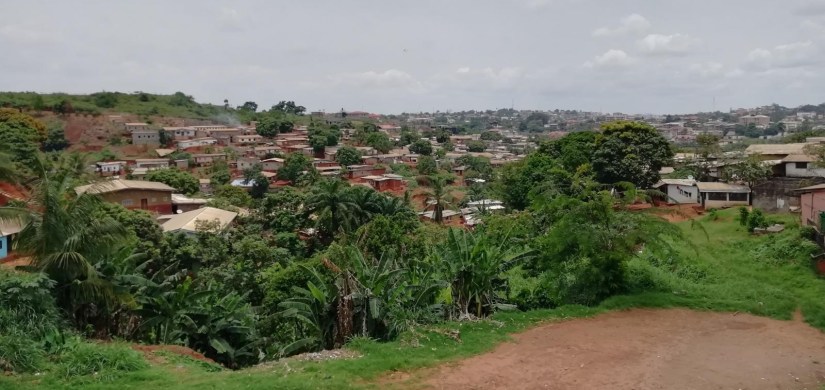
Bantu/Bantoid languages
Modelling Bantu Analytic Morphosyntax (MBAM)
My FWO project is entitled Modelling Bantu Analytic Morphosyntax (MBAM): The Mbam languages as a case study in morphosyntactic change, running Oct 2024–Sep 2027. It investigates the diachrony of analytic ↔ synthetic morphosyntactic change in Niger-Congo using a case study of the Western Mbam languages of Cameroon (Tunen [tvu], Nyokon [baz], Nomaandé [lem], Atomb [ttf]). The project includes data collection on the Mbam languages through fieldwork in Cameroon, as well as consideration of existing textual material (such as the Tunen texts transcribed by Idelette Dugast).
The main research topics are how to model the morphosyntactic changes that have taken place in the family and in the Mbam subgroup in particular, with consideration of phonological changes to verb forms that interact with changes to clausal morphosyntax. The project also involves general documentation of the lexicon and grammar of the less well-studied Mbam languages Nyokon, Nomaandé, and Atomb.
The project is hosted at Ghent University between the research groups UGent Centre for Bantu Studies (BantUGent), Diachronic and Diatopic Linguistics (ΔiaLing), and the Ghent Generative Grammar Group (G4).
Atomb revitalisation and documentation
The Western Mbam language Atomb (Atɔmb/Tuotomb/Boneck/Ponek [ttf]) is heavily endangered, with an estimated 50-300 remaining speakers. Alongside my postdoctoral project I am collaborating with Atomb community members on revitalising and documenting the language to teach to future generations. We are currently working on orthography development and a multimedia online dictionary, funded by the Foundation for Endangered Languages (FEL) and the Endangered Language Fund (ELF).
Tunen syntax and information structure (A44, Cameroon)
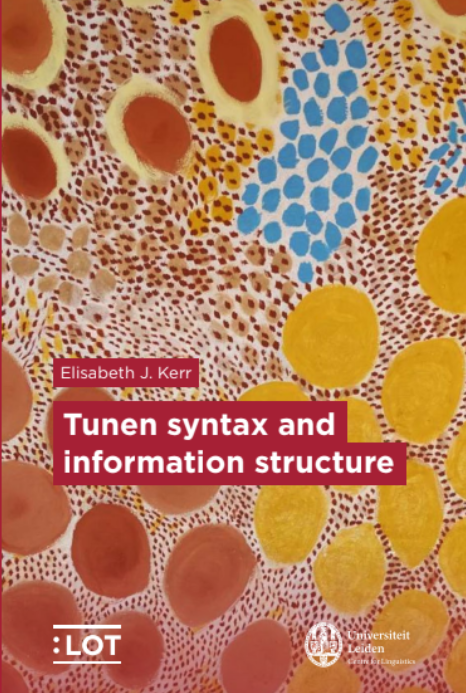 My PhD position was part of the Bantu Syntax and Information Structure (BaSIS) project, which investigated information structure across a sample of 10 Bantu languages. The project asked what role information structure plays in determining the syntax of Bantu languages and how this can be modelled theoretically. We collected new field data on Bantu languages using a custom methodology; the data are available online via The Language Archive.
I worked on the Tunen subproject. Tunen (also known as Nen, ISO-639-3 [tvu]) is a Guthrie zone A Narrow Bantu language spoken in Cameroon, bordering Grassfields Bantu varieties. Tunen has a number of distinctive properties from the Eastern and Southern Bantu languages investigated by my colleagues, such as OV rather than VO base word order. My PhD thesis covers:
- The (non-)influence of information structure on Tunen syntax
- OV vs VO word order patterns (with comparison to broader Niger-Congo)
- Discontinuity in the nominal domain
- A descriptive overview of Tunen grammar
- A theoretical analysis of Tunen syntax
You can download my thesis open access from the Leiden University repository and access the Tunen dataset via The Language Archive. You can read more about the (sub)project in the full project description, available from the BaSIS website, and find other related publications on the Output page.
Comparative Bantu linguistics
 Together with colleagues I work on comparative Bantu linguistics. In 2021 the BaSIS team organised a workshop Bantu Universals and Variation (BantUniVar) at the 10th World Congress of African Linguistics (WOCAL10), resulting in a special issue of Linguistique et Langues Africaines (9(1)). We co-wrote an article on how word order across Bantu varies between being determined by grammatical role (“subject”, “object”) and discourse role (“topic”, “focus”), based on work presented at WOCAL10 and ACAL51-52 (see Output page). I also co-presented a paper with Jenneke van der Wal on Indirect truth marking in 10 Bantu languages at Bantu9, SLE2022, and CALL52, published with Zeitschrift für Sprachwissenschaft. I also contributed a chapter on the expression of information structure in Tunen to the BaSIS project book on information structure in Bantu and co-wrote the introduction chapter with the other project members, published in March 2025 with Language Science Press.
The Zulu (S42, South Africa) conjoint/disjoint alternation in Dynamic Syntax
My MA dissertation at SOAS gave an empirical overview and analysis of the conjoint/disjoint alternation, a verbal phenomenon found in Eastern Bantu languages whereby a conjoint (also termed short/non-final) verb form alternates with a disjoint (long/final) form, e.g. in Zulu present tense affirmatives Ngicula ignoma `I sing a song’ vs Ngiyacula `I sing‘. Given that alternation is sensitive to whether the verb is in final position of the verb phrase as evaluated after any topicalisation/dislocation (A’-movement), I used Dynamic Syntax (Cann et al., 2005; Kempson et al., 2001) to model the phenomenon from an incremental, surface-oriented perspective. You can read my MA dissertation on the Output page.
Information structure in Ékègùsìí (JE42, Kenya)
During my BA in Linguistics, I conducted fieldwork in South-Western Kenya with speakers of Ékègùsìí. I studied the distribution of the focus marker /ne-/, arguing that it is realised in a left-peripheral focus position within a Cartographic clause structure. Interestingly, Ékègùsìí has V-Aux order, while other SVO Bantu languages have Aux-V. I proposed that this alternation is derived from underlying Aux-V order via focus-triggered movement, given that all such verbs are prefixed by the focus marker.
Other research
The -oo/-(h)ee suffix in Gorwaa (South Cushitic, Tanzania)
As part of my MA in Linguistics at SOAS, I conducted a corpus study to investigate the distribution of a nominal suffix in Gorwaa, an endangered South Cushitic language of Tanzania, based on a recent ELDP corpus (Harvey 2017). I presented my findings at the ConSOLE28 conference in Barcelona, January 2020 and published a proceedings paper in Dec 2020 (see Output page).
Computational approaches to low-resource languages
After my BA I spent a summer as an intern in computational linguistics with Africa’s Voices (AVF) and the Cambridge University Computer Laboratory, where I studied NLTK/Python and machine learning and worked on computational analysis of messages written in Sheng, an East African mixed language drawing largely on Swahili and English. This work was a collaboration between AVF, Cambridge University, and the Kenyan media organisation Well Told Story (now rebranded Shujaaz Inc), and findings were presented at the 2018 British Association of Applied Linguistics (BAAL) Language in Africa Special Research Group. You can find a blog post about my work on the AVF website.
Finally, I have developed a tutorial and teaching materials for the Dative web application for management of linguistic field data, which you can find on the Dative page.
 Elisabeth J. Kerr